Saturday, August 6, 2016

FAQ's

This blog is an attempt to answer some of the questions asked of us from both Costa Ricans and stateside family and friends.   In case you've been thinking to ask the same thing, read on...

But first:
     We got a little taste of life after PC last week, as we went to Ft.Collins for a quick visit to see good friends, Joachim and Ellen Viens, due to Joachim's illness. We were blessed to spend some time with Joachim before he died and are so grateful to have been allowed that leave on such short notice. What a gift Joachim was to us and all who knew him and especially to our Small (Spiritual) Group which he and Ellen were part of for over 30 years.
This blog is dedicated to Joachim, friend and mentor for over 30 years.

¿How is Francis doing?

F: I'm feeling great.  Ready to get back to work and finish up here.  I need to finish writing up the Friendship Circles and School Mentors Training manuals and working on the Diversity Committee. 

C: (I'll add a few more details); the PC doctors in DC confirmed the diagnosis of Polymyalgia Rheumatica, as well as the steroid treatment that he was put on by the CR doc.  All other tests they did trying to find some reason for his weight loss, were negative.  Results:  Weight loss is probably due to being very healthy: lots of walking and a diet high in fresh fruits and vegetables; maybe a little stress too :)>      Francis has had enough tests to last a lifetime!

Francis with Tayna, our new PC mentee from Tico 32, who visited last month.  Here, she's teaching Francis a few dance steps during a recent community music festival, something I haven't been able to do in 40 years! If PC has taught us anything in the last 2 years, it's that it's never too late to learn!

Typical questions asked by Ticos:

¿What are you doing here?  Teaching English, right?
C: Wrong.  ....  We're with the PC (explanation of PC).  We work with the youth in the community, teaching life skills, ie. how to work together, solve conflicts, problem solve, make good decisions. 

¿You teach in English, right?
 We teach in Spanish, and at this point,  we can actually understand most of what the kids say to us!
We do judge English Festivals, though, including Spelling Bees

¿You are a "pensioner" right?  (Almost all Ticos who are retired, are collecting a pension, so they expect we are living off of a pension too!)

 No, we are not collecting a pension.  We are living off of a small stipend provided by the US Government for our work as PC Volunteers.  (FYI: it covers, housing, food, local transportation by bus, which by the way, Embassy employees are forbidden to use, because it's "not safe".  Additionally, we get a $25/month vacation bonus. Francis and I have been able to support ourselves on our monthly stipend and some months, save for trips we've taken around CR!)

¿How do your kids feel about what you are doing?
 They see us as adventurers and have been very supportive!  We have been so fortunate that our kids are in a good place in their lives, with lots of good friends and family and are strong supporters of each other as well!

You are going to stay here, right? (in CR)
 No, we have family and friends we want to return to, as well as a house in Colorado.

That answer is usually followed by:

But you are coming back, right?
Yes, of course! (I don't know when, but don't want to hurt anyone's feelings. Actually, I'm going to keep working with the Rotary Club, encouraging partnerships with the Give A Book Program and funding for the Jumpstart English Camps taught by PCVs.  If it works out, I might help bring a group who wants to do service work here and coordinate with PC!)
I can pass on most insects, but this little guy really caught my eye!

Typical questions asked by American Friends & Family:

Are you coming back to the US?
Por supuesto!  Of course!

When?
  Our service will end on September 14 and we will be leaving for the states on the 15th.  We will be spending these next 6 weeks here wrapping up our programs and saying "Hasta luego". (They don't like to say goodbye, so 'see you later' will have to do!)

What was it like?  (Peace Corps)
    If you ask that question, your answer will depend on how much time we have to talk.  If you expect a one line answer, you will get this:

C: Peace Corps is like...the first day on a new job--for an entire year.

F: Peace Corps is like...going on a blind date, not knowing what to expect.

If you have 30 seconds, you'll get the elevator answer: 

C: It was a mixture of challenges, growth(dendrite growth from language learning; I recommend it for all seniors!, as well as a whole new skill set for doing youth development work!), learning to be patient and tolerant,  to live within another culture and learning to expect surprises on a daily basis.  
Mangrove Crabs; they were everywhere in the Refugio Curu on the Nicoya Peninsula. 

F: It was wonderful, frustrating, with many unexpected things, new adventures, linguistically challenging and a great learning experience.
We spent a lot of time waiting for buses.
If you want more details than that, I'll refer you to: campgaebler3.blogspot.com


What are you going to do when you get back?   Note:  All "plans" are subject to change.

Immediate plans: Upon leaving Costa Rica, we'll fly into Atlanta and make our way around to see Hannah, Emilee and Noah, visiting friends and family along the way, as we return to Ft. Collins!
Some of the Gaebler Family in Ft. Collins

C: Besides wanting to make myself available to friends and family in need, I'm looking forward to hiking, biking and fixing up our yard and house.  Other ideas: Rotary Club idea as above; continue to teach Mindfulness wherever the opportunity arises; continue studying Spanish and pursuing further studies in Restorative Justice/Practices, a field I have become interested in through trainings and opportunities I've had here in CR and in the past.

F: I'm not going to make any major decisions about my future in the first 3 months.  Ideas I have: take the Naturalist Training for the City's Parks and Open Spaces, meeting with folks in order to continue practicing my Spanish language skills and working on my house and gardens.
I hope Francis can make our roses at home look like these from our neighborhood here.

What kind of cultural traditions do you plan to carry on?
C: Simplicity in all things.  Hopefully a little bit of the slower paced life has rubbed off and making more things out of recycled materials.


This is a traditional BD dinner that Vilma made for Francis;
 what else but lentils and rice, with a picadillo (small chopped
vegetables) and ensalada.
F: Eating tamales at Christmas, singing Feliz Cumpleaños for birthdays in Spanish.


I love this outfit made for this week's Festival of the Arts
celebrated in all of the schools.  It is made out of recycled paper!
What experiences were unexpectedly wonderful?
Finding cool tide pools like this along the beach were wonderfully unexpected!
C: To have met a group of people who like to hike and take us with them to parts around Los Santos that no tour would ever go.
To have met a group of women who invited me into their small group and taught me the wonderful art of making mosaics  with ceramic tiles.
To have a host family amazingly tranquila and helpful in every way, who invited us into their lives and taught us so much about everything Costa Rican.

F: To have fresh, clean water and cool air and abundant fresh fruits and vegetables.  To have a great host family, to live in the mountains and be able to take long hikes on trails infrequently used.  To have great friendships with Costa Rican youth.

Francis is in his glory when with a group of kids!  They were making a "nudo humano" (human knot).


What will you miss the most?  
C: Mostly, the family and friends we made and being able to chat in Spanish.  Next, the availability of so much diversity of fresh fruits and vegetables,  the year round green with flowers blooming everywhere and playing in the ocean. Every picture you see in this post is an example of what we'll miss the most.

F: Living with Vilma and Monica, living a simple life with few possessions and walking everywhere. Abundant fruits and vegetables and the 12 months of summer with cool nights and warm days. 
Tomatoes with cucumbers and fresh hearts of palm with beets; prepared by Diego.
We'll miss meals with Carmen and Diego and friends.

If you could rate your PC experience on a scale of 1-10, how would you rate it?
That is an impossible question; how about we break it down?

OK, what were some 10's?

C: Making friends: both the Ticos from the PC office, in our community and the wonderful Tico 28ers, who were such a big part of our ongoing journey and support.  I'm so happy we will get to follow them along their new journey back in the states.
The Last of Tico 28 to end our service.

F: Our host family, the deep, close relationships with Tico 28 colleagues, having the opportunity to learn Spanish, living a simple life.
 Laura, the Training Manager and Valeria, our Youth Development Program Manager, whom we worked very closely with.

The entire PC staff participated in part of our Close of Service conference.  

We led them in a Zumba class to start the day and to demonstrate activities that some PCVs lead in their communities.


What were some of the 1's or 2's?
C: Totally feeling uncomfortable in my own skin for the better part of 9 months.  Being immersed in another culture with the goal of just learning another language is one thing, but with the goal of doing a community assessment, trying to understand their needs, identify what's going on around you in the schools (Where is everybody going?  Why is everyone leaving?  What's happening right now?  These were common questions).  And needing to make suggestions for programs that might help?  None of it felt comfortable to me.

F: There were none. (Francis has long term memory loss). 


Is it what you expected?
C:This is the million dollar question!
      While I tried not to have expectations, because you know that gets you in trouble every time, I'm certain I "expected" to work in a smaller community with a much greater poverty level.  This is probably the source of my biggest disappointment.  I felt like we were just whitewashing the problem of what the kids needed in the schools through what we were doing.  I felt like a greater impact could be made by working with the levels higher up in the system (of education).  But what I learned is: that is not the job of Peace Corps.  That is not what we've been asked to do, and PC is supposed to work within the given system/culture,  at the local level, helping to develop programs that the community or school agrees to participate in, on the problems that they have identified as needing improvement.  
Having said that; our frustrations were still expressed to our PC administration (Tico 28 was a very vocal group).  And, we found, that there were some positive outcomes to this expression.  In fact, as I described in the Jan. 2016 blog, Francis and I, along with another PCV from Tico 28, were invited to speak at a conference of the Ministry of Education Program Writers, to talk about the programs we were implementing in our respective schools.  Other advances are being made to try and get more participation and accountability with our local Project Partners, through partnering with administrators at the Regional level of MEP, besides the local level.  We are happy about those potential changes.
Besides that, it has taken me 2 years to actually get a handle on what the mission of Peace Corps is. Therefore my expectations have changed over time.
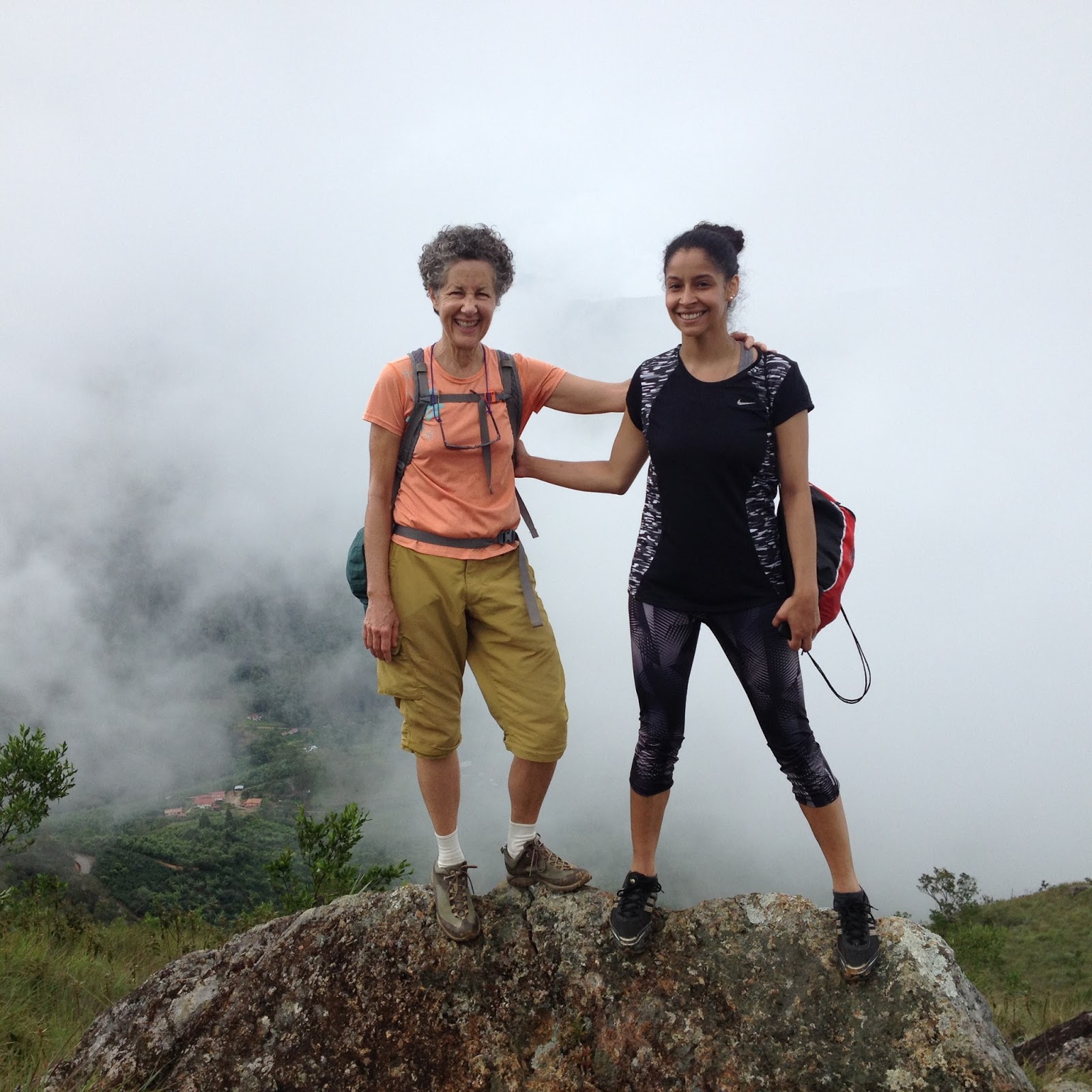
A lookout point on our way up to La Cruz, one of our favorite hikes.
 There wasn't much of a view that day!


Hiking down from the cross.


F: No, I expected to live in a much poorer town and in greater need of help than I found here.  I expected poorer sanitation conditions.
This beautiful orchid of Vilma's is growing right outside our door.


Did you find that being an "older PCV" gave you any special treatment?  or How was it being the Senior Volunteers of your group?
*Besides being asked if our fellow PCVs were our kids?

C: I found out from others in our Tico 28 group that they appreciated having someone ask the questions they were afraid to ask.  (I was one of the more vocal ones at all of our trainings; and rarely missed the chance to express my feelings about something).
I felt like one of the gang all of the time. We all supported each other.
(Francis was in DC when we took this picture).


F: I had advantages such as being given seats on the bus and going first in line at the Immigration Office and being served dinner at the table for Monica's graduation vs. having to stand in line. Seniors are treated with much respect here.


Do you see the impact you made?  
A Mentor Guia Group (10th with 7th graders); they are doing an activity to get to know eachother better: throwing around a ball of string while answering a question.
C: When I see how the 7th grade students interact with the 10th graders who are their mentors, I see the impact of the Mentor Guia program.  When the teachers tell me they use the Mindfulness activities I've been teaching in the 2nd grade classes, I see the impact.  When the 6th grade teacher sees the students fighting and tells them: "Remember what Francis and  Christine taught you?", I see the impact. (no, they haven't stopped fighting, but they might solve the conflict differently at times!).

F:  In the big picture, I see little impact. However, I do see little things that have happened that may make a difference, like the English teacher who is using some of the fun activities from Jumpstart Camp in her classroom and seeing a 7th grader using Mediation as a way of solving a conflict in the high school; something he learned as a 6th grader the year before in our classes. One impact that I know of for sure is that Vilma and Monica really like my mashed potatoes and lasagna!

Was it a worthwhile, satisfying endeavor?

C:Por supuesto.  It was an opportunity that I am so grateful(to the people of the US) to have been chosen to be part of. I went in with the goals of wanting to do volunteer work and learn Spanish.  I worked harder during those 2 years than I ever imagined and had an awful lot of fun along the way.  My Spanish is not where I had hoped it would be, but it's better than it was.  I'm ready to retire now!

F: My time as a PCV was very satisfying and enriching for me, even without knowing how I really impacted my students or counterparts over the longterm.  I am very grateful for this life changing experience.


Last beach I went to in July; Santa Teresa on the Nicoya Peninsula.


Monday, July 4, 2016

My New Norm; what I've grown accustomed to (and what I haven't)

     It's hard to decide what to write about as our time here narrows down to the last 3 months. You've seen and heard a lot about what we do for work here.   But since many of the highlights of June, didn't take place in Costa Rica, I thought I'd write about other things.
     First an update on our whereabouts.  I am back in San Marcos, Francis is still in Washington, DC.  He is being very well taken care of by the Peace Corps Medical Office, feeling good, getting examined from head to toe and leery of anything involving needles, but managing well.  He is making the most of his time while near so many wonderful monuments, museums and family.  Francis grew up in Baltimore and has been spending some time with cousins as well as a 99 year old uncle.  I got to enjoy much of this during my 8 day stay in DC, in addition to a visit from Emilee and longtime friend, Eileen.  They both came to DC for a weekend and we had a marvelous time together.  I got spoiled and wish I could have stayed!  That kind of sums up where I'm at mentally right now, but as always, practicing being in the here and now.  We're hoping and expecting that Francis will return here within the next 2 weeks, más o menos.

Francis and Emilee at the Marine Corps War Memorial in Arlington National Cemetery, where Francis has a great uncle buried.
Eileen and I at the Crab Cakes Bar
Sunset over the Potomac

      This week is the beginning of a 2 week vacation for all schools in CR; they call it "quince dias".  So while I spent the beginning and end of June working in the school and liceo, I am going to spend 4 days this week with my PCV group, Tico 28, at La Playa Santa Teresa and then the following week at our COS (Close of Service) Conference.  We will have about 2 months of service to go after that.
     Being back in the states for the week gave me another taste of life after Peace Corps.  It didn't feel like as much of a culture shock going as much as it did coming back here again.  It has given me much food for thought about differences in cultures and how I've adapted to things here.

Let's start with what I appreciate about Costa Rica that's different from the states:
   
     We live in a small town here.  I have grown so accustomed to living here, I forget it's such a small town. When the boys from Asheville were here, some were talking about how neat it was that the kids could walk to school, whereas in the states, they have to drive everywhere they go. The last time I climbed up to the cross and looked down at the town, it was such a great feeling to realize that we walked all the way up there from our house!  And going the other direction we can walk into town.  Case in point: in the States; we tend to drive everywhere we go, but we don't always have to.  Francis and I have put on a lot of miles walking around town, and now when someone offers us a ride, we usually decline, because we've grown so accustomed to walking that we prefer it.  Here's to hoping we continue walking a lot and don't hop in our car for a quick trip to the store.  I really do like small town living, so I guess I'll have to figure out a way to make Ft. Collins feel small again.
Hiking with other PCVs : Francis, Rachel, Nicky and Donny.
     When talking to my brother the other day on the phone, he asked about the rooster he heard crowing in the background.  I have grown so accustomed to it, I hadn't even noticed.  But I do notice it at 4 am when it wakes me up every morning.  As I've mentioned before, we live on a fairly busy street, and I am especially aware of the big trucks that have to downshift and grind their way up the hill.  But for now, it's quieter since coffee picking season is over.  It's amazing how we all adapt to the sounds around us.

 There's a church down the street whose visitors sing without accompanying music, and not exactly on key.  I can't say that I missed them when I was in DC.  On the other hand, no matter where I am, I tend to gravitate to quiet places, trails through the trees or along rivers or streams.  I will miss the many chirping birds that I hear every morning, but not the barking dogs outside my door.  The heavy rains certainly make memorable sounds on a tin roof, but it's the rain itself that is something you have to learn to live with whether you like it or not.  Like the changing seasons of Colorado, the rainy season here makes one appreciate the dryness of "summer".
Francis was well versed in the use of umbrellas when he arrived to DC.
     The plentitude of insects has been something that I have not adapted to well.  I've gotten used to catching spiders, cockroaches, roly polies and such, and tossing them out the door, but I'm not comfortable with crawling into bed or walking around barefoot for fear of meetings with unseen insects. Ticos are accustomed to having little gnats flying around their food in the kitchen, and for that reason, I don't keep food out. Traditionally, Ticos tend to keep food sitting out on the stove, in the microwave or toaster oven.  I keep a tube of rice at the bottom of our front door; not to keep the cold out, but to keep the insects out.  The joke's probably only on me, because with all of the spaces between the ceiling and the walls, there's plenty of other places for them to enter, but it makes me feel better anyway.
I've been told this "colorful" spider, which I found racing across our floor recently,  is probably toxic.   Any arachnoid scientists out there who can identify this?  It was only about the size of a nickel.

    I've grown accustomed to living in a small space.  It's so easy to sweep the entire apartment every morning (takes 5 minutes) and to reach for pots, pans and the sink while cooking.  I can open the refrigerator and get out some nuts or chocolate from my cozy little living room throne (mi trono)!  It's my desk, meditation spot, tv chair and sewing seat!  Sounds good huh?  Well, it's a little different story when Francis and I are BOTH here.  And it's a little challenging to entertain, though we have had 3 for dinner, seated on every chair in the house!  I'm sure it will only make me appreciate our spacious home when we leave and maybe on cleaning days too!  In the words of Ticos, who always use "ito, or isimo" on the ends of words to emphasize the smallness or grandness of things; we have un apartamento pequenito.
My arm's not long enough to see it all, but you get the idea!

    Seeing all the green around me is a site I have become accustomed to, and continue to appreciate every time I look outside!  There are blooming orchids, bromeliads and many other flowering plants right outside our door.  I so enjoy having fresh fruits and vegetables like bananas, lemons, papaya, mango, zuchini and tomatoes available to us year round!  

Freshly cut from Vilma's banana trees out back.
     I've become accustomed to eating much more simply and with less variety than we have in the states.  Besides savings for the budget, it makes shopping simpler as well, since there's not so much variety to choose from.  Americans tend to spend much more time on both shopping for and preparing extravagant foods than Ticos.  I think it's a product of both our economic level as well as our consumerism culture.  Maybe it's also a small town vs. big town difference that I'll have to pay more attention to.
   
Carmen cooking beans on the wood stove (estufa de leña).  Ticos LOVE their frijoles y arroz!
     While all Costa Ricans haven't embraced keeping the environment clean (like picking up trash), they have embraced the 2 new R's in the Reduce, Reuse, Recycle practice; and that's Repair and Refuse (to buy new).  Costa Ricans are very good at using things until they fall apart and repairing them when they do. In addition, they use recycled materials a lot more for many household items and demonstrate a lot of creativity in doing so!
Holding up the water pipes for the washing machine w/ an inventive cord system of Vilma's!
    Again, it's probably a matter of economics, but since we've lived here, and don't have any extravagant needs, we've also practiced repairing things much more than we have in the past.  In the states, our practice is to throw it away and buy a new one.  Of course, the former is better for the environment and I hope to spend more time getting creative in the process!
I may have chosen a little longer lasting solution to this broken trash basket for the long term, but duct tape and cardboard  work just fine for the short term!
     Something else I've become accustomed to, but not something I've enjoyed, is the frequent feeling of not knowing what's going on, due to the language barrier.  This is referred to as "Arroz con mango",  a saying used when a situation is confusing.  My auditory processor has slowed down enough so that it makes it quite difficult to understand what people are saying much of the time.  This has caused us to stop short of knowing what's going on many occasions over our entire stay here. We've both become quite used to that feeling, but it's always been an uncomfortable feeling.    While one of the reasons I joined PC was to learn Spanish, it's been a challenge much greater than I ever thought it would be (like the Ticos say about learning English: "cuesta mucho" (literally, it costs a lot).  And while I plan to continue my studies of the language,  I look forward to having a little more than a clue about what's going on around me and being able to interact on a deeper level when I return.
At least Yuey and I understand each other.
     It could be that it's not just a language issue causing the confusion as I mentioned above,  but a greater cultural misunderstanding or difference.  For example, a quality in many Ticos that, I've learned to accept but not embrace quite yet is the "pura vida" attitude, which serves Ticos very well in many ways, maybe the most important ways. They are a very tolerant people, patient and forgiving. This is probably the opposite of many Americans, with our highly demanding and efficiency minded workplace expectations.  This creeps into our personal, family and everyday lives and leaves us stressed and sick.  Those values have been so engrained in me, that it's been hard to adapt and accept what I see as inefficiencies in the systems where I work here.  It's worth the thought though,  that maybe this "Pura Vida" is saving Costa Ricans from a lot of misery.  Maybe it's something the US could adopt from Costa Rica, that would improve our society.  If we could trade a bit of efficiency or productivity for more tolerance, patience and forgiveness, it might be worth it!

     Costa Rica is one of the highest rated "developing" countries, according to where PCVs are placed. There are many similarities of culture to that of the US.  Many Ticos whom I've met, want so much to travel to if not live in the states.  Their tv shows and  movies are Spanish dubbed US shows.  Walmart is prevalent all over CR (though it's called Pali in the smaller towns, like ours).  Clothes are very western and stores called "Ropa Americana" (with used clothes from the states and Canada) are everywhere.  The US has influenced CR and other countries all over the world in many practices, so the differences aren't always so striking.  But Ticos have a LOT of pride in their country and this is very evident at their many festivals and parades, with old fashioned oxcarts pulling agricultural products, school and municipal bands playing national anthems and folkloric dancers wearing beautiful traditional costumes.
Tico Folkloric Pride

Tico Diversity Pride: Peace Corps led the Diversity Parade last week!


I hope that as you celebrate the 4th of July, you appreciate the rich cultural influences that make the US the beautifully rich, diverse country that it is, that makes it so wonderful.   Happy 4th!
I was invited to lunch w/ friends Carmen and Diego, so I made my traditional 4th of July Jello, to meet PC Goal #2: share the US culture with those from your host country!


Saturday, June 4, 2016

Life: Una Montaña Rusa (A Roller Coaster)

     Over the months, I've taken many notes about what I might write about on my blog, but none of them seem to fit when I get down to writing.  It's more about what's happening at the time and how I'm feeling when I sit down to write.
     So while April was the month of surprises, May was the month of the Roller Coaster, or La Montaña Rusa (literally, the Russian Mountain).
     We experienced our first high on La Montaña Rusa, early in May when we took our first trip to the States since we've been in PC.  We flew to Georgia where Chad's folks live.  They picked us up, treated us to good 'ole fashion Southern hospitality including black-eyed peas, collard greens and cornbread. The next day we drove onto Asheville together for Hannah's graduation.  Hannah now has her MS degree as a Family Nurse Practitioner.  Since her graduation, she has not only passed her licensing exam, but also was offered a job at what she describes as her "Dream Job"!  It's at a Community Clinic, near Asheville, where she will get to serve the Spanish speaking population, as well as all others.  She's quite excited!

Ken and Alice Romano, Hannah, Chad and us      
   The rest of the family came the following week; thus the celebrations continued for Birthdays, beautiful Spring days, Summit Dog days, Lazy days on the river, opening of New Belgium Brewery, Biltmore Mansion tour, Bent Creek hikes and anything else we could think of to celebrate!
Noah and Allie in front of their Dream Home.  The Biltmore Mansion.
Inside a tunnel on the Biltmore grounds; just jumping 'cause we can


Floating on the French Broad, just 5 minutes from Hannah and Chad's house
Emilee only fell 3x from the Paddle Board!  Francis didn't fall at all.


Enjoying some of the fresh brews at New Belgium after a hard day on the river. Felt like we were back in the Fort!

Emilee and her Niece Dog, Summit

Outside time at Hannah and Chad's
We returned to our classes at the school, where I'm teaching 2nd graders Mindfulness activities, to strengthen their Corteza Prefrontal, or La Parte Intelligente (the smart part of the brain), by learning to calm themselves and pay attention better.  We have fun with Mindful Movement, listening and breathing activities.
All the while this has been going on, Francis had been suffering with significant joint pain for months and juggling work with waiting for appointments to see specialists.  After returning from Asheville, he was finally diagnosed w/ Polymyalgia Rheumatica (which Hannah first diagnosed correctly when we were there), and he was put on steroids with immediate relief.  So while he's feeling much better, he just learned from PC/US that he can't be "in country" while on steroids.  Also PC, wants to make sure that he has the correct diagnosis.  And for that reason, Francis will be returning early to the states, first to Wash.DC for an unknown period of time, before going back to Colorado.  So some of you will be seeing Francis sooner than later.  Our Close of Service conference is the 2nd week of July and I don't want to miss that.  We'll talk about how to wrap up projects and transition back to the US.  For most, it's about finding jobs or going to grad school, etc.  For me, it will be a time of saying goodbye and reflecting on the last 2 years.  If Peace Corps has taught us anything, it's how to be flexible, so we are managing just fine with the news.  Mostly we're grateful for Francis' newfound health!
On the extreme low part of the Roller Coaster this month, was the death of my nephew, Austin Pieper.  Austin was taken way too soon, by the illness called depression and anxiety.  He had another side though, and that was his smiling self that most of us knew better.  He  left his legacy in being the laughter in the room and a good friend to many.  Austin was a really good listener,  one in a million and will be sorely missed.  My brother Jim's family could use many healing thoughts and prayers.  

Our last huge event of the month, which was honestly very difficult to carry out after hearing the news of Austin's death and coming down with a cold, was hosting 12 boys from an Asheville school like we did last year.  We had found host families for all of them and organized and participated in 5 days worth of activities.  Here are some of the things we planned for them:
 Cole, and his host family, the Leandro's.
The boys helped in an elementary and high school English class for a day.
Along with the Girl and Boy Scouts of our town, the boys helped us with a ceramic mural at a park.  It's a project that I hope to finish before I leave.
They helped Adolfo with a Trapiche; making syrup and sweets from sugar cane. This is something I had been wanting to be part of since I was first introduced to Tapa de Dulce.  Adolfo was extremely generous to spend his entire day doing this, just for us!  He gave us each a chunk of the "tapa de caña" the hardened sugar, to make either syrup or "Aqua Sapo", a sweet drink, that's made w/ some of the sugar, hot water and a squeeze of fresh limon.

And during the day at Adolfo's, the boys got to play in the "barro".  What a day!
And finally, we tried to wear them out on a hike up to the cross. Guess who got worn out?

Hosting the boys from Asheville, fulfills PC Goal 3, sharing the culture of CR with others from our own country.  I was happy to be involved with it and it was a lot of fun, but given the timing, it was also draining and I'm very relieved it's over.

  I'm feeling like I want to get off the roller coaster.

 Like I said in my last blog, we have gotten used to surprises during our PC service, and surprises come in good and bad forms.  They are part of the Roller Coaster of Life that we are all on.
Bendiciones a todo. 
Blessings to all.